 GEARSTUDIO
Planetary gear ratio calculator and formulas
A planetary set has three rotating members: the sun, the ring and the planet carrier. Hold one still, drive another, and the third becomes the output. The ratio depends only on the sun and ring tooth counts and on which member you fix.
Calculator
- Sun (input)
- 1000 rpm
- Carrier (output)
- 211.11 rpm
- Planet, on its pin
- -576.5 rpm
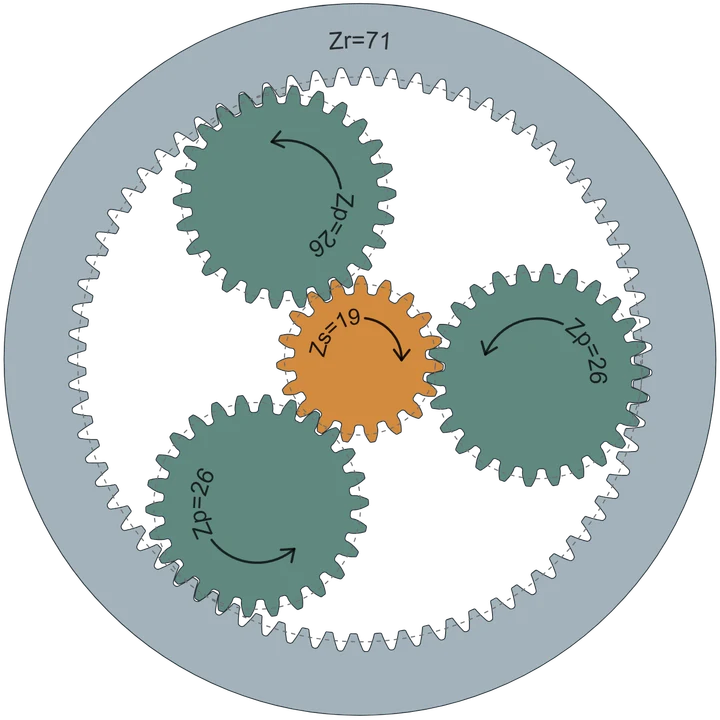
- Coaxial: ring = sun + 2 × planet (19 + 2 × 26 = 71)
- Equal spacing: (19 + 71) / 3 = 30, a whole number
- Neighbour clearance: 10.97 × module between planet tips
How do you calculate a planetary gear ratio?
Every planetary ratio comes from one relation. Seen from the carrier, the set is an ordinary gear train: the sun drives the planets, the planets drive the ring, and sun and ring turn in opposite directions at the ratio of their tooth counts. Writing that in the fixed frame gives the Willis equation:
Here ω is the speed of the sun (s), ring (r) or carrier (c), and Z is a tooth count. The set has two degrees of freedom, so setting one speed to zero and choosing another fixes the third. The planet tooth count does not appear: the planets act as idlers between sun and ring.
What is the ratio with the ring, sun or carrier fixed?
The ratio below is input speed divided by output speed. A value above 1 is a reduction, below 1 is an overdrive, and a negative value means the output turns the opposite way to the input. The last column uses the 19 / 26 / 71 set from the calculator.
| Fixed | Input | Output | Ratio | 19 / 71 |
|---|---|---|---|---|
| Ring | Sun | Carrier | 1 + Zr/Zs | 4.7368 |
| Ring | Carrier | Sun | Zs / (Zs + Zr) | 0.2111 |
| Sun | Ring | Carrier | 1 + Zs/Zr | 1.2676 |
| Sun | Carrier | Ring | Zr / (Zs + Zr) | 0.7889 |
| Carrier | Sun | Ring | −Zr/Zs | −3.7368 |
| Carrier | Ring | Sun | −Zs/Zr | −0.2676 |
The ring-fixed, sun-input arrangement is the one most gearboxes use, because it gives the largest reduction in one stage while keeping input and output on the same axis. With the carrier fixed the set stops being epicyclic at all: it is a simple train with the planets as idlers, and the output reverses.
Worked example
Take a sun with 19 teeth, planets with 26 and a ring with 71, ring fixed, sun driven at 1000 rpm.
- Carrier speed from the Willis equation with ωr = 0: ωc = 1000 × 19 / (19 + 71) = 211.11 rpm.
- Ratio: 1000 / 211.11 = 4.7368, the same as 1 + 71/19.
- Planet speed on its pin, relative to the carrier: −(ωs − ωc) × Zs / Zp = −(1000 − 211.11) × 19 / 26 = −576.50 rpm.
- Planet speed in the fixed frame: 211.11 − 576.50 = −365.38 rpm. The planet bearings see the 576.50 rpm figure, since they turn with the carrier.
How much torque does a planetary gear set output?
Ignoring friction, power in equals power out, so output torque is input torque multiplied by the ratio. The fixed member carries the difference as a reaction. For the ring-fixed, sun-input case the carrier delivers Ts × (1 + Zr/Zs) and the ring housing reacts Ts × Zr/Zs. The load is shared across the planets, which is why a planetary stage carries more torque than a spur pair of the same size.
How do you choose tooth counts for a planetary set?
The ratio formula alone does not guarantee a buildable set. Three tooth-count rules decide whether the parts go together:
- Coaxial: without profile shift, Zr = Zs + 2·Zp, so the planet count follows from the sun and ring.
- Equal spacing: (Zs + Zr) / N must be a whole number for N evenly spaced planets.
- Neighbour clearance: adjacent planets must not touch tip to tip.
The assembly conditions guide covers each rule with worked numbers. Small suns also run into undercut; see gear undercut and profile shift. In practice a single ring-fixed stage usually lands somewhere between about 3:1 and 10:1. Lower ratios need very small planets, and higher ones need a sun too small to carry much torque.
Design the set, watch it run, and export STEP, STL or DXF once the numbers work.
Open GearStudio